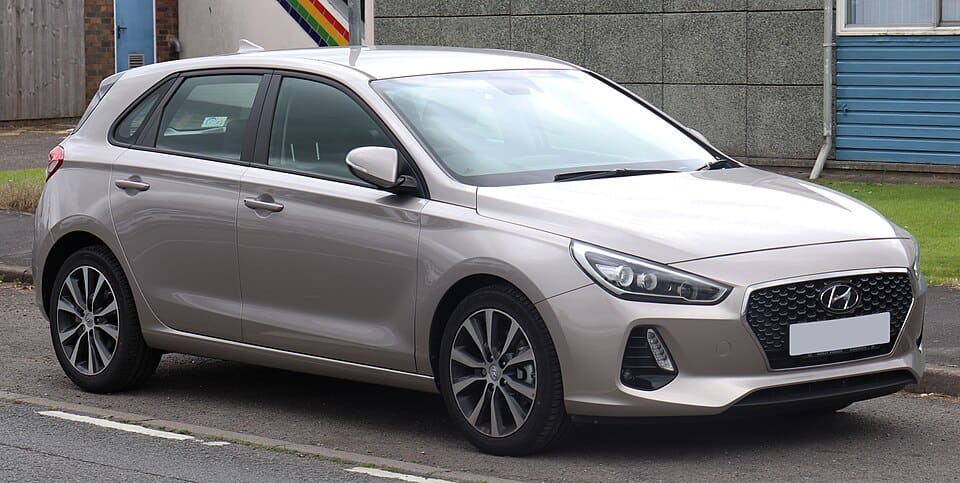
Hatchback · 2017–2024
Hyundaii30
Quiet Golf rival. i30 N is a proper hot hatch; N Line is the lookalike. Estate Fastback variants add body choice.
Best for: Drivers who want Korean value with optional N thrills.
Indicative running costs ~£2,053–£2,895 / year
- Power
- 120 hp
- Economy
- 45–52 mpg
- Fuel
- Petrol
- Boot
- 285–395 litres
- 0–60
- 8.5–12.5 sec 0–60 mph
- Ins. group
- Grp12–28, depending on trim and power
Owner essentials
The lookups people actually search for — pressures, oil and spare status. Confirm against the V5C engine code and door sticker.
Tyre size
Commonly 195/55 R16 – 225/40 R18
Tyre pressure (cold)
Often ~30–36 PSI cold for small hatches; check the sticker
Engine oil
Usually 5W-30 or 0W-20 meeting the maker approval on the oil cap / handbook
Oil capacity
Typically ~3.5–5.5 litres
Spare / puncture kit
Spare, space-saver or sealant kit — check the boot well
ULEZ
Most petrols from ~2006 (Euro 4+) are ULEZ compliant — verify the plate
Need a PSI ↔ bar converter? Tyre pressure tool →
UK running costs
Ballpark annual ownership for a private Hyundai i30 at ~8,000 miles/year.
~£2,053–£2,895 / year
| Cost | Indicative yearly figure |
|---|---|
| Fuel | ~£1014/yr @ 52 mpg, £1.45/L, 8,000 miles |
| Road tax | ~£195/yr typical post-2017 standard rate |
| Insurance | £550–£1,100 (indicative) |
| Servicing | ~£240–£400 for a typical annual service |
| Tyres (avg) | ~£100–£260 averaged over a set |
- · Assumes ~8,000 private miles/year — scale up/down with your mileage.
- · Insurance is the wild card: age, postcode, NCB and claims history matter more than the car alone.
- · Figures are illustrative UK ballparks for planning — not quotes. Use our running-costs tool for a custom budget.
Variants & trims
GTI / ST / R-Line / AMG Line are not the same thing — match the boot badge and V5C engine code.
| Variant | Engine | Power | Economy | Road tax |
|---|---|---|---|---|
S / SE 1.0 T-GDi Daily petrol. 1.0 T-GDi · 45–52 mpg | 1.0 T-GDi | 100–120 hp | 45–52 mpg | ~£195* |
Premium / Premium SE Kit levels. 1.0–1.4 · 45–52 mpg | 1.0–1.4 | 120–140 hp | 45–52 mpg | ~£195* |
N Line Looks like N — not N power. 1.0–1.4 T-GDi · 42–50 mpg | 1.0–1.4 T-GDi | 120–140 hp | 42–50 mpg | ~£195* |
N Line + DCT Auto N Line. 1.4 T-GDi DCT · 42–48 mpg | 1.4 T-GDi DCT | 140 hp | 42–48 mpg | ~£195* |
i30 N Proper hot hatch. 2.0 T-GDi · 30–35 mpg | 2.0 T-GDi | 250 hp | 30–35 mpg | £0–£195* |
i30 N Performance LSD / bigger brakes — PDE options. 2.0 T-GDi · 30–35 mpg | 2.0 T-GDi | 275–280 hp | 30–35 mpg | £0–£195* |
Fastback N Shooting-brake hot hatch. 2.0 T-GDi · 30–35 mpg | 2.0 T-GDi | 250–280 hp | 30–35 mpg | ~£195* |
Tourer estate Wagon. Various · 45–55 mpg | Various | 120–140 hp | 45–55 mpg | ~£195* |
1.6 CRDi Diesel option. 1.6 diesel · 55–65 mpg | 1.6 diesel | 110–136 hp | 55–65 mpg | ~£195* |
*Indicative annual UK VED. Confirm on GOV.UK.
Full specifications
Buying a used i30
- 1i30 N: check for track days and PDE options
- 2N Line ≠ N
- 3Verify dual-clutch vs manual
- · Confirm the exact engine code, trim and gearbox on the V5C before ordering parts
- · Check the latest MOT history and advisories on GOV.UK
- · Compare cold-start behaviour, warning lights and service invoices before buying
Common faults to check
Inspection prompts — not a diagnosis.
- DCT fluid neglect
- Front suspension knock
- Infotainment glitches
Hyundai i30 FAQs
Is a used Hyundai i30 expensive to run in the UK?
As a rough guide, many owners should budget ~£2,053–£2,895 / year including fuel, tax, insurance, servicing and tyres at ~8,000 miles/year. Hotter trims and young drivers cost more.
What tyre pressure does a Hyundai i30 need?
Often ~30–36 PSI cold for small hatches; check the sticker. Pressures change with load and wheel size — the legal reference is the sticker in the door shut or fuel flap, not the sidewall maximum.
What oil does a Hyundai i30 take?
Usually 5W-30 or 0W-20 meeting the maker approval on the oil cap / handbook. Capacity is Typically ~3.5–5.5 litres. Wrong oil on wet-belt / LongLife engines can be an expensive mistake — confirm by engine code in the handbook.
What are common Hyundai i30 problems?
Buyers most often watch for: DCT fluid neglect; Front suspension knock. Always cross-check MOT history and a pre-purchase inspection.
Is the Hyundai i30 ULEZ compliant?
Most petrols from ~2006 (Euro 4+) are ULEZ compliant — verify the plate
Owner handbook
Official Hyundai manuals for exact oil grades, torque figures and fuse maps. We link out; PDFs stay with the manufacturer.
Hyundai owner manuals ↗Guides & tools
- Buying a used car in the UK: checklist →
- How to check tyre pressure correctly →
- How to check if your car is ULEZ compliant →
- Dashboard warning lights explained →
- How to prepare your car for its MOT →
- How to change a flat tyre safely →
- How to change your engine oil →
- How to jump start a car safely →
- Running costs calculator →
More Hyundai

Reviewed October 2026. Photos: Wikimedia Commons. Cost figures are illustrative UK planning ranges, not insurer or DVLA quotes. Manufacturer handbook and UK model-year specifications GOV.UK MOT guidance and vehicle test standards Owner and workshop inspection patterns; verify against the specific VIN